Boy and Stick
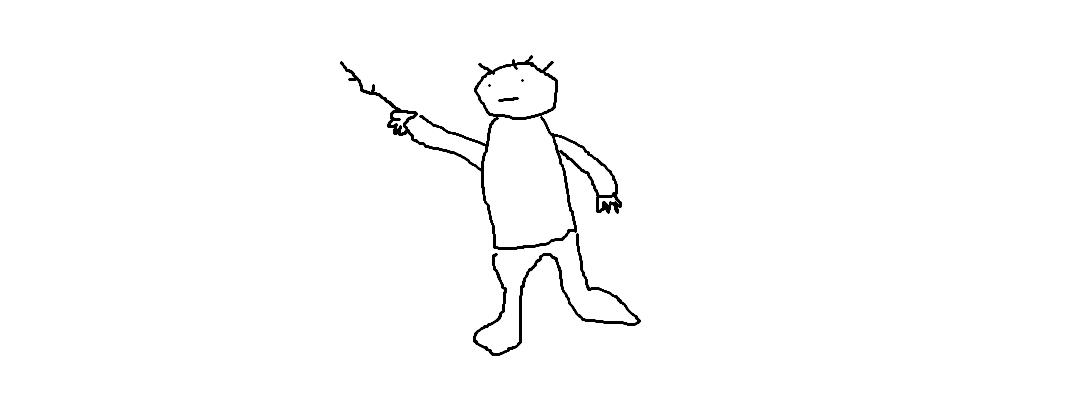
There was a boy who was born and given the usual equipment, two hands, and he used one of them to grab a stick. He found it on the ground and after that he was a boy and a stick. This was the beginning of his career. Nobody had issued him the stick. He found it. This tells you something about him, or about sticks, it is hard to say which.
He learned to walk and the stick walked with him. It followed him like a tail. The boy combined with the stick made for a small machine meant for one purpose, which was finding out what things felt like. It had three settings, poke, smack and drag. That was the machine. Scientists could have opened him up and found only this and a normal amount of blood and probably some chips, a quarter, the usual amount of Legos. They would have closed him back up and written it down and gone home to their own children, who were also doing this, in their own ways, with their own sticks.
The fence gave back one knock per slat. Every slat gave back a different knock and he wanted all of them. The whole length of the block. He did the brick. He did the corrugated metal and the metal sang and he filed this all away.
He was reading the street. He read the curb. He read the puddle and the puddle had the sky in it and he dragged the stick through the sky. He read the family dog. He read the tree. Often nobody saw him doing this, and it counted anyway. Things count whether or not anybody sees them. This is a good piece of news, and it is free, and not everyone uses it.
He got older the way you do, which is to say he did not notice until it had mostly happened. And still the stick.
The stick wore down at the tip where it touched the world. Occasionally the world came back the other way and he got a splinter and he would carry that for a while too, until it worked its way back out of his hand. He went through a few sticks over the years. He was loyal to each one until it was gone and then he found the next one on the ground.
He was nine and he was forty, both at once, on a given day, on a wall or fence or door, and it did not feel like a long time. He ran the stick through the house and the dog was no longer there. That summer they poured a new sidewalk and somebody had already put their hand in it and he put the stick next to the hand.
And when the stick was worn down to the size of a pea he stopped and looked at it in his palm and put it in his mouth and ate it, and it tasted pretty good.
And then he dropped dead and the scientists opened him up and found a normal amount of blood and a few quarters and chips and many Legos, a small Lego city. And gathered somewhere near the middle of him, every stick he had ever worn down, each one the size of a pea. He had eaten all of them. They wrote down the number and closed him back up and went home, where their own children were out in the yard dragging sticks along the fence, taking every slat, and the scientists called them in for dinner and did not think anything of it.